
Summary
LinkedIn doesn't become a revenue channel through viral posts, but through the interplay of content, community management and outreach. To turn reactions into meetings and revenue, you need a system behind it with defined stages, automated handover and reporting.
When I emigrated to southern Italy with €2,700 in my pocket, I had one clear goal: to build my own online business. No huge ad budget, no existing network. My only lever: LinkedIn. Within 8 months I grew from practically zero to more than 6,000 followers, with weekly inbound enquiries and outreach that worked. Today I run exactly this done-for-you system for entrepreneurs and managing directors, so they get a predictable 3 to 8 qualified meetings per week in their calendar.
The reality at most companies looks different, though: they post 2 to 3 times a week, put hours into writing, and the inbox still stays empty. The reason: content alone is not a sales system.
How does content build trust before the conversation starts?
Content is your digital lever. It makes sure decision-makers already know who you are, what you stand for and what results you deliver, before the first message is even typed. But many people post textbook knowledge nobody remembers. Three things make the difference:
- Opinion and edge: Decision-makers look for expertise, not checklists.
- Measurable results: Real case studies convince faster than any sales promise.
- Personality: People buy from people, especially in the high-ticket space.
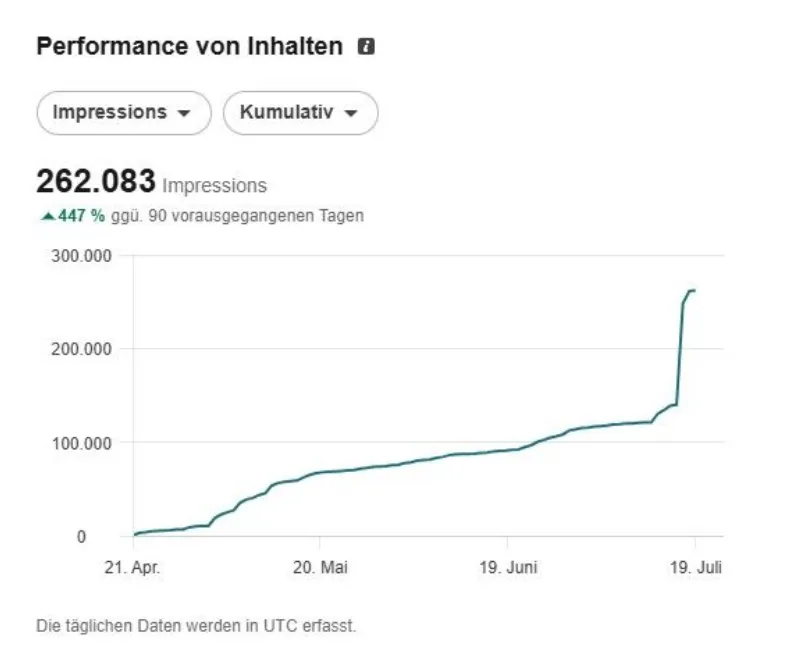
The result in practice: one of my clients received an invitation to an international podcast with his very first post. One client profile reached more than 260,000 impressions in around 90 days, organically and without an ad budget, an increase of 447% compared with the 90 days before.
Why does community management put you in front of the right people?
If you only post and then close the app, you only use part of the potential. Your content mainly reaches your existing network. Comments actively put you on the radar of people who don’t know you yet.
- Presence under your target audience’s posts: When your ideal clients post, we show up there with well-founded, quick-witted contributions, as equals.
- Use industry multipliers: Targeted comments under posts by big industry voices send relevant profile visitors straight to your page.
- Use your own comment section as an entry point: Every comment under your posts is the start of a potential sales conversation.
How does attention turn into a qualified meeting?
Content builds the stage, comments bring the audience, but the deal happens in the direct messages. Professional outreach always connects to real signals: who liked or commented on your posts? Who visited your profile? Where has there already been a professional exchange? Through individual, qualifying dialogue we filter out exactly who really has a need.
A concrete example: one of my clients paused his cold outreach completely after just three months, because he was simply fully booked. The combination of organic content and a targeted DM process brought in so many qualified inbound enquiries that his calendar was full. The goal of every conversation is simple: a direct, focused intro call (20 to 30 minutes) to check whether working together is a fit.
What happens after a contact has replied?
Content builds trust. Community management puts you in front of the right people. Outreach turns attention into a conversation. But the real question, which stays unanswered in most setups, comes after that: what happens after a contact has replied?
In the sales systems we set up at ORYN, we see this pattern regularly, regardless of whether the enquiry comes from LinkedIn, a referral or cold outreach: the reply lands in an inbox, a spreadsheet or the founder’s head. There is no defined stage, no rule for who follows up when, and no overview of how many conversations are currently open. That works as long as one person carries the entire system in their head. It breaks the moment volume builds up or a second person joins sales.
Content, community and outreach create signals. Without a system, most of them get lost.
A like, a comment, a profile visit, a reply to a DM: these aren’t coincidences, they are buying signals of different strength. If you don’t capture them in a structured way, you treat every signal the same and in the end you stop making decisions and only react.
- Defined stages instead of gut feeling. Every contact who reacts on LinkedIn gets a clear stage in the CRM, not “somewhere in the inbox”. We work with exit criteria per stage: what exactly has to happen for a contact to move from “reacted” to “qualified” to “meeting booked”?
- Automated handover instead of manual copy-paste. As soon as someone reacts, the system itself should know where this contact stands and what the next step is. This is exactly where founder-led sales typically breaks: it works as long as one person carries everything, and fails as soon as a second person, a second profile or a second channel is added.
- Reporting instead of guesswork. How many conversations really come from LinkedIn, how many turn into a meeting, how many into a deal? Without that number you don’t know whether your LinkedIn system works or just looks busy.
Content, community and outreach decide whether signals are created at all. Whether they become a predictable revenue channel or just a well-filled inbox is decided by the system behind them. That is exactly the work we take on at ORYN.
Conclusion
Content builds trust before the first conversation begins. Community management puts you in front of the right people. Outreach turns attention into a conversation. And a system makes sure that conversation doesn’t turn into lost data, but into a predictable revenue channel.
If you want to turn your LinkedIn profile into a real sales system, Luana shows you how content, community and outreach work as one: Book an intro call with Luana now.
And once the replies are coming in and you no longer want to manage them by hand, we at ORYN build the system behind it: Get in touch with ORYN.
Frequently asked questions
How many meetings are realistic with a LinkedIn sales system?
The goal of the done-for-you system is 3 to 8 qualified meetings per week in the calendars of entrepreneurs and managing directors.
How long does it take for content to bring in enquiries?
For Luana, it took 8 months to go from practically zero to more than 6,000 followers, with weekly inbound enquiries. One of her clients was so fully booked after three months that he paused his cold outreach.
Why isn't content alone enough as a sales system?
Content builds trust and visibility, but deals happen in conversation. Without community management and outreach the inbox stays empty, and without a system behind it, signals get lost.
What belongs in a LinkedIn sales system?
Defined stages with exit criteria in the CRM, an automated handover after every reaction and reporting that shows how many conversations turn into meetings and deals.
About the authors